Meetings don’t suck. We suck at running meetings.
That’s the premise of the book by world renowned business expert Cameron Herold. In the book, he teaches you how to use focused, properly run meetings to help you and your company grow.
As usual, the inspiration for this week’s blog comes from a recent coaching session with a wonderful couple whose business is doing great things. They’re building a big, profitable business and have started adjacent companies that their sons are also running. By most measures, they’re a roaring success. But one area where they need some help is creating a proper structure for running their meetings.
When you learn how to run productive meetings, they not only work, they also make your people and your company better.
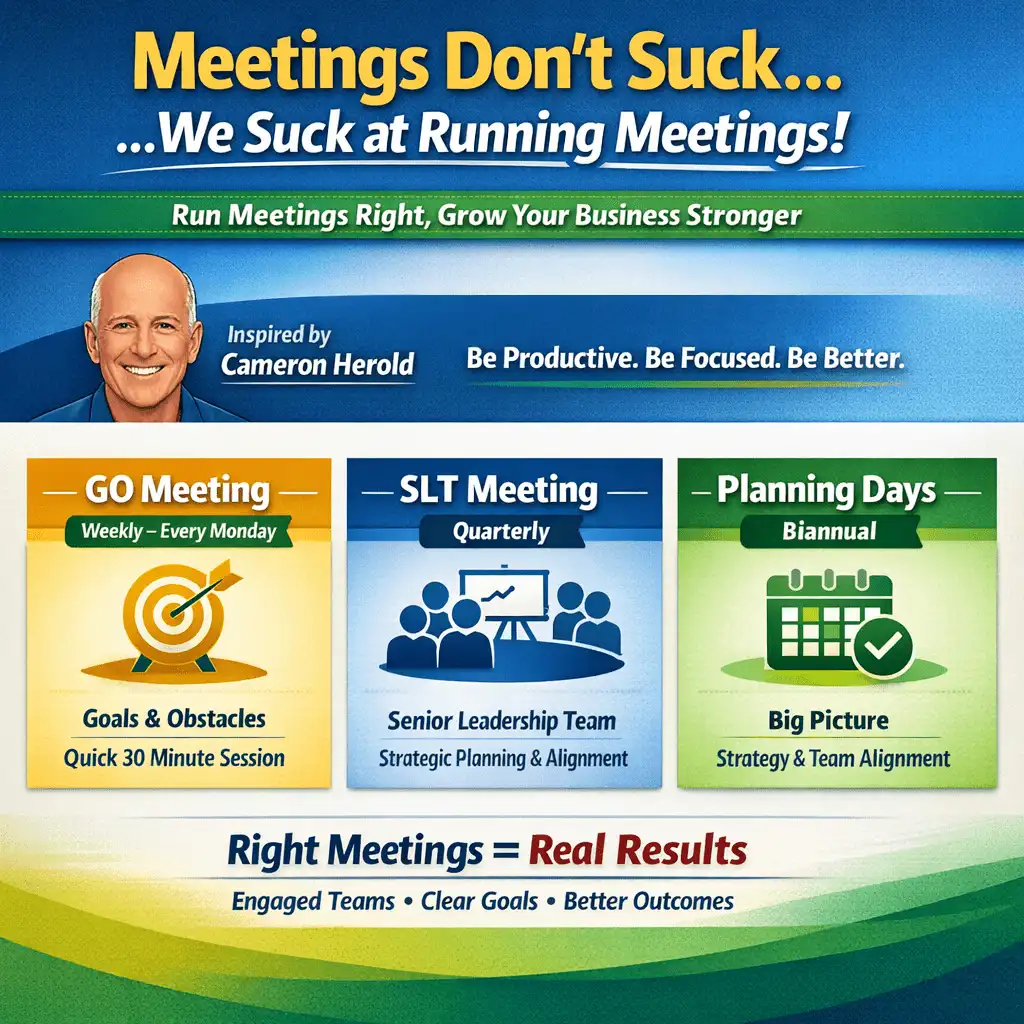
At EBS, our meeting rhythm is carefully designed to balance immediate execution with long term strategy. It takes the form of three main meetings, each with a different cadence and intention.
- GO Meeting, weekly cadence (every Monday at 9 am)
- Senior Leadership Team (SLT) Meeting, quarterly cadence
- Planning Days, biannual cadence
The GO Meeting (Goals & Objectives)
Every Monday, we hold a 30 minute GO meeting. We’ve adopted a version of what’s often referred to as a ‘GO Meeting’, a concept popularised by Ryan Montgomery from ClickFunnels and shared more broadly through Cameron Herold and the COO Alliance.
All key department heads from coaching, events, sales, client experience, finance, and legal attend.
- We begin with a WIFLE (What I Feel Like Expressing), ensuring everyone’s voice is heard and, most importantly, creating a space for anything causing perturbation to be shared openly, without judgement or animosity.
- We then celebrate the wins, reinforcing successes across the business.
- The core of the GO meeting is sharing each team’s goals and obstacles. By surfacing roadblocks, we aim to make decisions on the spot and eliminate bottlenecks that can slow progress.
Ideally, we’d like to remove ourselves from the decision-making process as much as possible, but if you’re the leader of the business, you will be a bottleneck from time to time. The GO meeting is a great place for the team to get the answers they need in real time. It sure beats having questions awaiting your approval stuck at the bottom of an inbox.
SLT Meeting
Quarterly, we run a two day Senior Leadership Team (SLT) meeting. Each department head provides a pre read performance report that is shared a few days prior to the meeting. The intent is that sessions focused on operations become less about presenting and more about clarifying and probing.
By the end of Day 1, we will have worked across every critical function in the business: coaching, finance, sales, marketing, events, and client experience. This shouldn’t be a series of updates, but rather a view of how the business is performing and where people need help.
The real power, however, comes from how these areas connect. By hearing them together, in sequence, we start to see the interdependencies and the cause and effect across the business. Where one area is thriving, another may be under pressure. Where momentum is building, constraints may be forming.
By the close of the day, the goal is simple: shared clarity. Everyone in the room understands not just their own function, but how the entire business is operating, where the pressure points are, and where the opportunities lie. That alignment sets the foundation for far better strategic conversations on Day 2.
On Day 2, we focus on the business, not in it, by tackling strategic priorities. These priorities come directly from the SLT, who submit their top three focus areas in advance. We then prioritise the items based on which focus areas appear most often across the team. From there, we discuss them in detail, agree on next steps, and align on the future.
Planning Days
Every six months, we bring the entire team together for our planning days. These run over a day and a half, and wherever possible, we do them in person. As the business grows, the investment in getting everyone in the room becomes more significant, but so does the return. There is something powerful about having the full team aligned in the same environment, away from the day to day, and focused on the bigger picture.
We start by sharing a transparent view of performance across the business. This isn’t just a highlight reel. It’s a clear and honest look at what’s working, what isn’t, and why certain decisions have been made. The intent is to give every team member context, so they understand not just what we are doing, but the reasoning behind it. When people understand the “why”, alignment becomes far easier and execution becomes far stronger.
From there, we shift our focus forward. We map out the key initiatives, projects, and priorities that will shape the next phase of the business. This is where we connect strategy to action, ensuring everyone understands where we are heading and how their role contributes to that direction. It creates a shared sense of ownership across the entire team.
A critical component of these sessions is open discussion. We deliberately create space for questions, challenges, and ideas from across the business. It gives people the opportunity to raise what’s on their mind, seek clarity, and contribute to the direction of the company. This level of openness not only improves decision making, it builds trust and strengthens the culture.
We also carve out dedicated time for education. We bring in the frameworks, concepts, and thinking that we teach our clients, then apply them internally. This ensures our team is continually developing, both professionally and personally, and that we are living the same standards we expect from the businesses we work with.
When you step back and look at the full rhythm, weekly GO meetings drive execution, quarterly sessions shape strategy, and these biannual planning days create alignment, context, and capability across the entire team.
Together, these rhythms keep everyone on the same page, help us move faster when things change, and make sure we’re learning as we go, not after the fact.
Cheers,
Darren Gloster
CEO – Australia & New Zealand
Entrepreneurial Business School